





The Cameras, Lighting, and Production Gear We Use
At Rocket House Pictures, equipment serves the production. The camera, lighting, sound, and support systems all need to work together, hold up through a full filming day, and give our crew enough flexibility to handle changing conditions.
Good equipment makes a difference, but the specifications alone do not create a successful video. The crew still has to understand how to use each tool and when to choose a different one. As we explain in our article about how poor-quality video can hurt a business, technical problems can distract viewers and weaken the message.
Our equipment gives us control over the image and sound during production. It also gives us room in post-production to adjust color, refine audio, build motion graphics, and prepare the finished video for its intended platform.
Our Camera Fleet
Our primary cameras are built around a Panasonic production ecosystem. Working within the same camera family helps us maintain consistent color across interviews, b-roll, and multi-camera productions. It also allows our crew to move efficiently between camera bodies without rebuilding the entire workflow for every setup.
Our main lineup includes three Panasonic EVA1 cinema cameras. Each EVA1 has a 5.7K Super 35 sensor, approximately 14 stops of dynamic range, V-Log recording, and dual native ISO settings of 800 and 2500. The cameras record 4K at up to 60 frames per second and 2K at up to 240 frames per second. Built-in neutral-density filters provide 2, 4, and 6 stops of light reduction.
Internally, the EVA1 records 10-bit 4:2:2 All-Intra files at up to 400 Mbps using H.264/AVC compression. Compatible external recorders can support additional workflows involving formats such as Apple ProRes and CinemaDNG.
The EVA1 remains on the official Netflix approved-camera list when used with the required firmware and 4K 422 All-I 400 Mbps recording settings. Netflix also provides a detailed EVA1 camera production guide for productions working within its capture requirements.
For productions that need a larger camera system, we have a Panasonic VariCam LT. Its native 4K Super 35 sensor provides more than 14 stops of dynamic range, V-Log capture, and dual native ISO settings of 800 and 5000. It is well suited to commercial, documentary, and narrative work where consistency, low-light performance, and a durable production body are priorities. Netflix has also published a production guide for the VariCam family.
Our smaller b-roll cameras include several Panasonic GH6 and GH7 bodies. Their compact size makes them useful for gimbal work, travel, documentary coverage, small interiors, and filming situations where a larger cinema camera would slow the crew down.
We select cameras according to the concept, location, crew size, recording format, and final delivery requirements. When a client needs a specialized camera or lens outside our regular inventory, we rent it. This gives the production access to the right system without requiring us to purchase equipment that may only be used occasionally. It is also part of our broader approach to more sustainable video production.
Select cameras and production tools from our regular inventory are also available to rent.
Lighting for Studio and Location Work
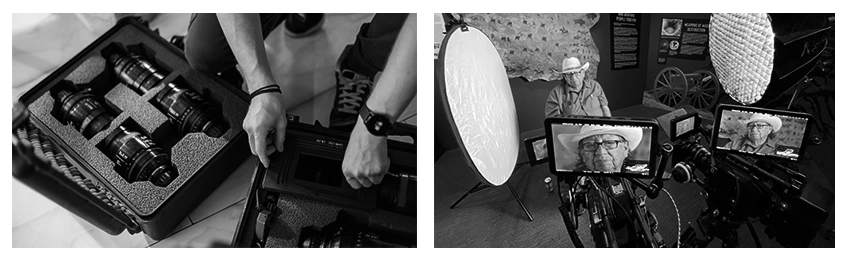
We use Aputure LED fixtures, modifiers, and lighting controls for interviews, commercials, documentaries, studio productions, and location work. The lineup includes point-source fixtures, panels, compact lights, softboxes, reflectors, grids, and other tools for controlling the direction and quality of light.
Our lighting package also includes equipment from Intellytech, a cinema-lighting company based in Denver. Combining fixtures from both companies gives the crew options for soft interview lighting, controlled product work, larger spaces, and compact locations.
The lighting package travels in our Mercedes Sprinter AWD van with the rest of our production equipment. Keeping the main system organized in one vehicle helps us arrive prepared and reduces the number of separate equipment trips required for many productions.
Camera Support and Movement
Some scenes benefit from a locked frame. Others need a slow programmed move, handheld energy, or stabilized movement through a location. We choose the support system according to the shot instead of adding movement simply because the equipment can do it.
Our primary movement tools include:
- DJI RS 4 Pro: This gimbal stabilizes compatible camera and lens combinations while the operator walks or moves through a location. We use it for tracking shots, documentary coverage, b-roll, and scenes that need fluid movement without a dolly or track.
- Kessler Second Shooter Pro: This programmable motion-control system can operate a motorized slider with pan-and-tilt control. It is useful for repeatable slides, pans, tilts, interviews, product footage, and time-lapse sequences.
- Edelkrone HeadPLUS V2: Our HeadPLUS V2 provides motorized pan-and-tilt movement and can be paired with a compatible slider. Its compact footprint works well for controlled moves in smaller spaces and for repeatable motion during product shots or time-lapse work.
Tripods, shoulder rigs, handheld configurations, sliders, and gimbals each create a different visual effect. The right choice depends on what the audience needs to see and how the movement supports the scene.
Post-Production
Once filming is complete, the footage moves into our post-production process. This is where we organize the material, edit the story, adjust color, refine the sound, create graphics, and prepare the final deliverables.
We use Adobe Premiere Pro and After Effects throughout that process. Premiere Pro is our primary editing environment, while After Effects handles motion graphics, compositing, titles, cleanup, and visual effects. The connection between the two programs allows footage and graphics to move between applications without interrupting the larger edit.
Reliable cameras and production equipment give us stronger material to work with, but they remain tools. The decisions made by the cinematographer, director, sound team, editor, and client determine how those tools are used.
Every project calls for a different combination of cameras, lighting, movement, sound, and post-production. Our job is to choose that combination carefully and use it well.
Contact Rocket House Pictures to discuss the equipment, crew, and production approach for your next video.
