





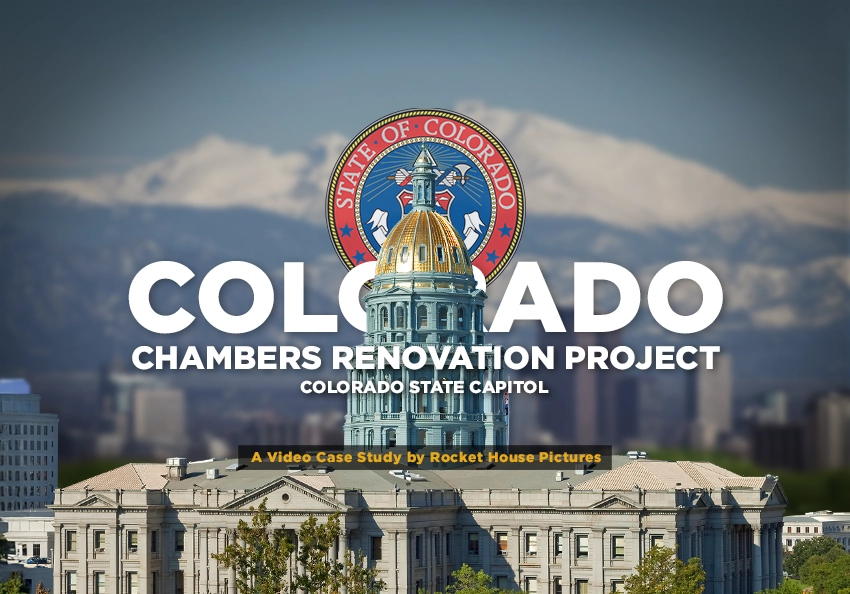
The chambers of the Colorado House and Senate are working rooms. Laws are debated there, votes are cast, and the General Assembly returns every January. When the State of Colorado began restoring both chambers, the work had to happen between legislative sessions without erasing evidence of what crews discovered along the way.
The Colorado Department of Personnel and Administration’s Office of the State Architect issued a bid for a production company that could document the project over several years. Rocket House Pictures was selected to record the restoration as it unfolded.
Lance Shepherd, Manager of Design and Construction Programs at the Colorado Office of the State Architect and project architect for the chamber restoration, served as Rocket House’s principal contact.
The assignment required much more than scheduled interviews. Our crew had to remain available during business hours for discoveries, inspections, wall imaging, construction milestones, and moments that could not be recreated later. Eight time-lapse cameras ran around the clock, four in each chamber. They were checked weekly and repositioned as the work changed, sometimes daily.
Three years of construction, interviews, discoveries, and time-lapse photography eventually had to become one 32-minute film.
A restoration that began with a crooked radiator cover
The Colorado General Assembly first occupied the Capitol in 1894. The earliest known dated photograph of the Senate chamber is from 1905, and that image became an important reference for the restoration.
Over time, the rooms changed. A 1954 remodeling project attempted to improve acoustics by covering the walls and skylights with white acoustic tile. The installation concealed much of the original decorative work, altered the appearance of both chambers, and attached tile directly to historic plaster.
The restoration began unexpectedly. According to the National Trust for Historic Preservation, former House Speaker Frank McNulty requested repairs to a crooked radiator cover in 2011. When workers removed part of the surrounding material, they found original filigree stenciling beneath the acoustic tile.
The House had once been green. The Senate had been red. Both contained ornate decorative work that had remained hidden for more than half a century.
That initial discovery led to a broader investigation. State officials selected Anderson Hallas Architects and a design-build team in 2013 to restore the chambers while updating their lighting, acoustics, electrical systems, and audiovisual infrastructure.
The restoration would return the rooms to their documented early twentieth-century appearance while allowing them to continue serving a working legislature.
Why the restoration needed to be documented
Removing the 1950s acoustic tile exposed physical evidence that had been inaccessible for decades. Some discoveries changed the restoration plan. Others raised questions that could not be answered from surviving drawings or photographs alone.
Each two-foot acoustic tile had been attached with four large applications of animal-based glue placed directly on the original plaster. Craftspeople tested ice, heat, and chemical treatments before determining that water and careful hand rubbing offered the safest removal method.
Behind the tiles were hand-painted stencils associated with Denver artist Manuel Hill. Contractors also found traces of an earlier decorative campaign beneath the visible 1905-era finishes. Specialized imaging, including infrared photography performed with assistance from the Denver Art Museum, helped record animals, shields, figures, and other patterns hidden below later paint.
The suspended ceilings had concealed ornate 30-by-30-foot skylights and damaged portions of their pressed-metal vaults. Historic chandeliers required disassembly, rewiring, and code upgrades. Seventeen stained-glass panels were cleaned and repaired. Paint analysis identified 12 custom colors in the House and 10 in the Senate.
The work involved more than 50 craftspeople, 37 subcontractors, 46 suppliers and service companies, and more than 75 people working on site, according to Building Dialogue’s account of the restoration.
Once a wall was covered, a chandelier reinstalled, or scaffolding removed, the earlier condition could not be filmed again. Documentation had to happen alongside the restoration.
The request: Remain ready for discoveries
The Office of the State Architect needed a production company that could work inside an active government building and respond when an important event occurred.
Construction schedules do not always align with film schedules. A craftsman might uncover a stencil in the morning. A wall examination could be scheduled with limited notice. A historic fixture might be removed only once. Rocket House remained on call during business hours so those events could be recorded when they happened.
Our access extended across the three construction phases, each completed between legislative sessions. The design and construction teams generally had from June through December to complete a phase before lawmakers returned.
That compressed calendar left little room for missed footage. The documentation plan had to accommodate construction, preservation reviews, Capitol operations, security, contractors, legislative schedules, and the availability of interview participants.
Eight cameras recording around the clock
Rocket House installed four time-lapse cameras in each chamber, creating an eight-camera system that recorded continuously.
The cameras needed regular maintenance throughout the project. Batteries, media, framing, dust, changing light, scaffolding, and construction activity all had to be monitored. As crews moved through the chambers, cameras were re-positioned to preserve clear views of the work.
Some placements remained useful for days or weeks. Others had to change daily as scaffolding rose, decorative elements were uncovered, and contractors shifted to another part of the room.
The time-lapse footage gave the documentary a visual record that ordinary site visits could not provide. Months of incremental work could be seen in seconds: chambers emptied, scaffolding filled the rooms, ceilings opened, finishes changed, and the historic spaces gradually returned.
The Colorado General Assembly continues to present a time-lapse of the Senate restoration on its official website.
Rocket House also created several shorter companion edits showing the progress inside each chamber.
Interviews with the people responsible for the work
Time-lapse footage could show physical change, but it could not explain why a treatment was selected, what a discovery revealed, or how a craftsperson approached an original surface.
Rocket House recorded hours of interviews with legislators, architects, contractors, Capitol staff, consultants, and craftspeople. The participants represented different parts of the project:
- Legislators described the public role of the chambers.
- Architects explained the historical research and design decisions.
- Project managers addressed scheduling and construction.
- Preservation specialists discussed original materials and treatments.
- Lighting and engineering consultants explained how new systems could be installed without damaging historic fabric.
- Craftspeople described the physical work of restoring plaster, metal, glass, paint, and decorative finishes.
These interviews are the driving force of the film and gave the restoration a human record. They preserved the voices of people who made decisions, uncovered evidence, and performed work that future visitors might otherwise see only as a finished room.
The central editing problem: Three years in 32 minutes
By the end of production, Rocket House had accumulated a lot of b-roll from the two chambers, plus the footage from eight time-lapse cameras, numerous interviews, preservation investigations, construction milestones, basically, hundreds of hours of footage inside the Capitol.
The final documentary could not function as a complete technical archive. It needed to become a story that visitors without architectural or preservation training could follow.
The edit was organized around a clear progression:
- How the original chambers looked.
- How the 1954 alterations concealed their historic character.
- How a radiator repair exposed what remained underneath.
- What architects and craftspeople discovered.
- How the team balanced preservation with lighting, acoustics, safety, and the needs of a working legislature.
- How both chambers emerged from the restoration.
- A message for current and future generations
The film gives important discoveries enough time to register while continuing to move through the three-year process. Interviews explain the decisions. Time-lapse sequences show scale and progress. Close observations of hands, surfaces, tools, and materials preserve details that a finished-room photograph cannot.
The dome restoration is acknowledged as part of the larger period of preservation work at the Capitol. Rocket House did not document the dome extensively because the commissioned film centered on the House and Senate chambers. The dome work provides context for the wider effort to stabilize and restore the building.
Remarkable filmmaker. Gio Toninelo is an award winner. The end product he provided the State of Colorado exceeded our expectations. --- Doug Platt - Communications Manager, Colorado Department of Personnel & Administration (DPA)
The result: A public record of work for the future
The chamber restoration was completed in three phases, concluding in December 2015. The final project restored the appearance of both chambers while incorporating current lighting, acoustic, electrical, safety, and audiovisual requirements.
The wider restoration received a 2016 AIA Colorado Award of Merit. The National Trust for Historic Preservation, Colorado Real Estate Journal, AE Design, and other preservation and construction sources documented the project and its discoveries.
Rocket House’s documentary created a separate record: moving images and firsthand accounts captured while the work was still underway.
In 2017, the film received the Audience Award for Best Short Documentary at the Intendence Film Festival.
The documentary is still serving Capitol visitors
The documentary continues to be shown as part of the Colorado State Capitol’s visitor experience. The Colorado General Assembly reports that the building welcomes approximately 300,000 visitors annually, with nearly 70,000 people taking Capitol tours.
The project remains part of Colorado’s public record. The Colorado General Assembly’s Senate Chamber Restoration page documents the chamber’s history and provides access to restoration photographs, books, and video. Footage recorded by Rocket House Pictures was also used in Colorado Preservation’s 2017 State Honor Award video, where Rocket House is credited alongside the State of Colorado for providing footage.
Documentation as part of preservation
Historic restoration changes a building by returning lost elements and introducing systems required for current use. Once the work is complete, visitors see the result. They do not see the glue behind the acoustic tile, the faint pattern found beneath another layer of paint, the damaged metal above a suspended ceiling, or the discussions that determined what could be saved.
The documentary preserves those intermediate moments.
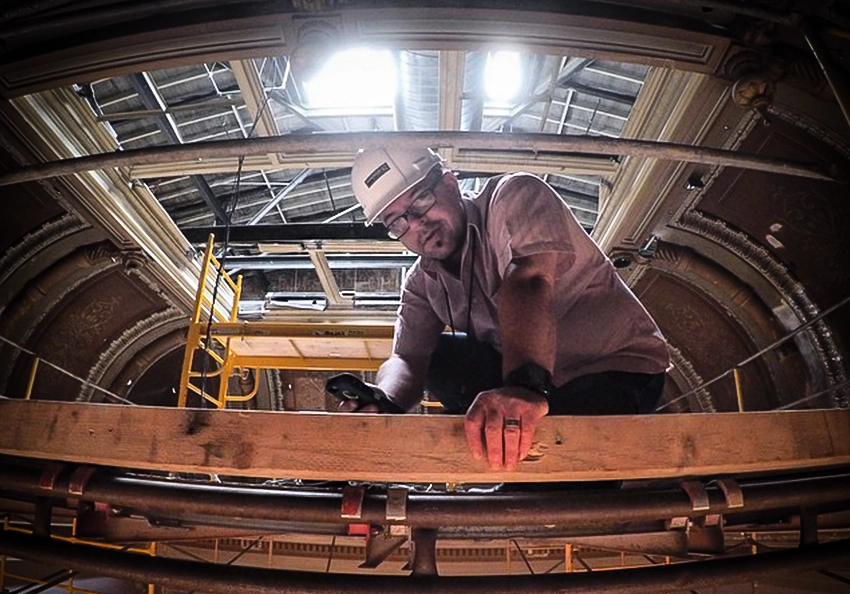
It records craftspeople working at full scale inside the chambers. It shows the temporary structures, exposed surfaces, experiments, discoveries, and uncertainty that existed before the final decisions were made. It also preserves the explanations of the people who were there.
For the Office of the State Architect, the film documented a major public project. For Capitol visitors, it explains why the chambers look as they do. For future historians and preservation teams, it provides images and testimony from a period of the building’s history that has already passed.
This is the lasting value of documentary production for a public institution. The camera becomes part of the record.
Rocket House Pictures works with state agencies, cities, public departments, and preservation teams through our Colorado government video production services. Our team can manage long-term documentation, interviews, time-lapse systems, filming inside active facilities, and post-production for projects involving public history and civic infrastructure.
Explore more work in the Rocket House Pictures portfolio, or contact our Denver production team to discuss a documentary or long-term documentation project.
