





Video quality shapes trust. In Wyzowl’s 2026 survey, 89% of consumers said the quality of a brand’s video affects how much they trust that brand. The same report found that 82% of video marketers saw a good return on their investment. Those numbers put some weight behind a decision many marketing teams face: should we make this ourselves or hire a professional video production company?
I’ve spent more than 20 years working in production, and I can tell you that the camera is only one part of the job. A strong video depends on dozens of connected decisions: the audience, message, interview questions, schedule, crew, lighting, sound, locations, edit, music, graphics, captions, and final formats. Miss one early, and the problem usually shows up later, when it is harder and more expensive to fix.
Hiring a professional video production company gives you an experienced team that can manage the entire project from concept through delivery. A full-service video production company provides a clearer plan, a crew built for the assignment, better control of time and budget, and finished assets designed for the places your audience will see them.
Here are ten practical reasons that investment can pay off.
1. Your video starts with a clear purpose
The first question should never be, “Which camera should we use?” It should be, “What does this video need to accomplish?”
A professional production company helps define the audience, the main idea, the desired response, and the distribution plan before anyone begins writing a script or booking a location. A fundraising film and a corporate recruitment video may both feature interviews, but they ask different things from the viewer. Their structure, tone, length, and call to action should reflect that.
This early work prevents a common problem: a video that looks good but tries to say too much. When the goal is specific, every creative choice has a job. The result is easier to understand and easier to measure.
2. Pre-production prevents expensive surprises
Production days move fast. An overlooked power outlet, noisy HVAC system, missing permit, late interview subject, or room with no control over daylight can chew through hours.
Pre-production planning is where a professional team gets ahead of those issues. Depending on the project, that work may include research, creative development, scripting, interview planning, storyboards, shot lists, scheduling, location scouting, permits, casting, travel, insurance, and a detailed call sheet.
It may look like a lot of preparation for one day of filming. That is exactly why the day works. Good planning protects the schedule and the budget while giving the crew enough room to catch an unscripted moment when it appears.
3. You get the right crew for the job
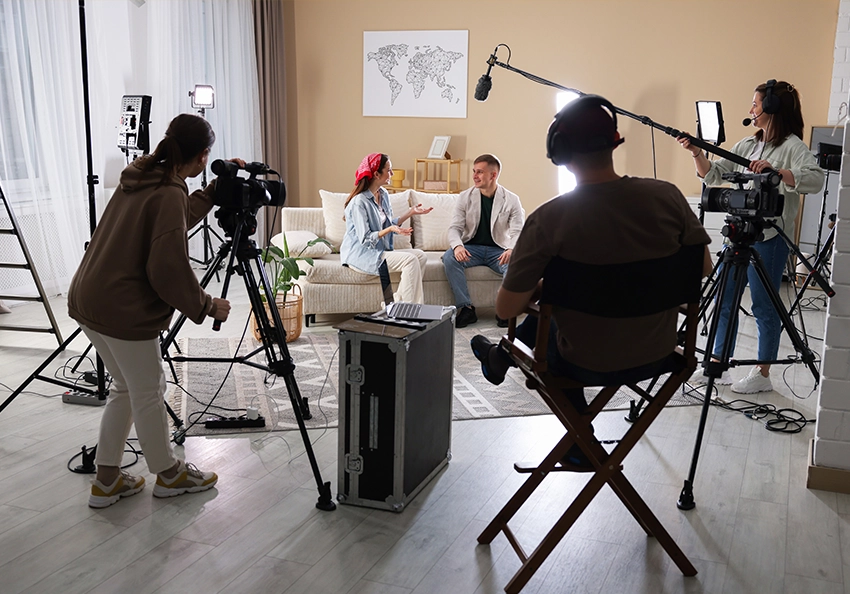
Some projects can be handled by a small team. Others need a producer, director, cinematographer, camera operator, gaffer, sound mixer, production assistant, hair and makeup artist, or FAA-certificated drone operator. A professional video production company knows which roles matter for the scope and which ones would add cost without adding much value.
That division of labor makes a noticeable difference. The cinematographer can concentrate on the image while the sound professional listens for a buzzing light fixture. The director can stay present with the person being interviewed while the producer keeps the schedule moving. Each specialist protects a different part of the final video.
Just as important, an established crew already knows how to work together. Less time is spent figuring out responsibilities on set.
4. Professional equipment is chosen for the situation
A phone can record a sharp image. So can many affordable cameras. The harder part is maintaining a consistent image and clean sound across changing conditions.
Professional filming and video production services include access to cameras, lenses, lighting, grip equipment, microphones, monitors, stabilization, teleprompters, and backup systems. The team selects those tools with restraint, then knows how to use them and what to do when a setup changes.
A bright factory, a quiet executive office, an outdoor interview, and a tabletop product shoot all need different tools. The production team builds a package around the location, subject, schedule, and intended look. That makes the footage easier to edit and far less likely to need a reshoot.
5. Your people receive experienced direction
Most employees, customers, donors, and community members are not trained performers. Put them under lights, clip on a microphone, and point a camera at them, and even a confident person may tighten up.
Experienced directors know how to create a calm set, ask better follow-up questions, and help someone speak in their own words. This is especially important in customer testimonial videos, where a rehearsed answer can weaken the credibility of the story. Directors also listen for the sentence that needs another pass, the missing detail that gives an answer context, or the small personal observation that makes an interview feel specific.
This matters in scripted work, too. A director watches pacing, emphasis, body language, eyelines, and continuity while keeping the performance connected to the video’s purpose. Good direction saves time in the edit because the editor has stronger material to work with.
6. Your staff can keep doing their actual jobs
An internal video can appear inexpensive until staff time enters the equation. Someone has to coordinate schedules, write questions, reserve rooms, learn the gear, manage files, troubleshoot audio, edit revisions, and export several versions. That work can pull a marketing manager or communications team away from its regular responsibilities for days or weeks.
A production company owns those details. Your team still contributes its knowledge and approves key decisions, but it does not have to run the entire production.
This is especially valuable on a busy filming day. Employees can arrive for their interview or scene, get clear guidance, and return to work. The crew handles the setup, schedule, equipment, media, and breakdown.
7. Post-production gives the footage structure
Filming creates ingredients. Editing makes the meal.
An editor reviews the footage, finds the strongest moments, builds a clear sequence, removes repetition, and controls the pace. Post-production can also include sound editing, audio mixing, color correction, color grading, licensed music, titles, animation, visual effects, captions, and review rounds.
Each detail affects comprehension and continuity. Clean audio helps viewers stay focused. Motion graphics can make a technical idea easier to follow. Color work gives footage from different cameras and locations a consistent appearance. Music supports the pace without fighting the speaker. Music selection also carries a legal responsibility because musical compositions and sound recordings are protected by copyright.
Professional video editing also includes the less glamorous work of organizing footage, backing up media, tracking versions, and delivering files that play correctly where you need them.
8. The finished video fits your brand and each platform
The same master video rarely works everywhere without adjustments. A website header, YouTube upload, LinkedIn post, Instagram Reel, paid ad, conference screen, and internal presentation may require different lengths, aspect ratios, captions, openings, and calls to action.
A production company can plan those deliverables before filming. That affects how shots are framed, how long an interview answer needs to be, and how much room the composition leaves for graphics or vertical crops.
The team also keeps the visual choices aligned with your brand. Fonts, colors, logo use, on-screen language, photography, and sound should feel connected across every version. Captions improve access for viewers who are Deaf or hard of hearing, and they can help people follow a video in places where sound is unavailable. Viewers may encounter the clips weeks apart on different platforms, but the organization behind them should still feel consistent.
If the video will live on your website, the delivery plan should also account for Google’s video SEO guidance, including stable thumbnails, crawlable embeds, and accurate video metadata.
9. One production can create a library of useful content
A smart production plan looks past one final video. The same shoot may provide a primary film, several short social media edits, interview clips, a website cut, vertical versions, still frames, behind-the-scenes material, and footage that can support future campaigns.
This approach can improve the value of the production without turning each deliverable into a separate shoot. It does require advance planning. The crew needs to know which formats are required, which lines should stand on their own, and which shots need extra space for alternate crops.
Wyzowl’s 2026 survey found that 85% of video marketers said video helped generate leads, while 82% said it increased website traffic. Image quality plays one part. Performance also depends on matching the content and format to a specific audience and use. Rocket House Pictures has a separate guide to the financial benefits and ROI of video production, while Wistia’s 2026 State of Video report offers broader benchmarks drawn from more than 13 million videos.
10. You gain one team responsible for the whole project
Video production involves many handoffs. A full-service company connects them under one plan and one schedule.
The producer knows what the editor will need. The director understands the approved message. The cinematographer sees the visual references. The post-production team knows the delivery requirements. If a location changes or an interview falls through, there is a person responsible for adjusting the plan and communicating the impact.
That accountability reduces confusion for the client. You know who is managing the budget, who is gathering feedback, and what happens next. You also have a team that can spot a weak link before it reaches the final cut.
For organizations with a public reputation, a launch date, a fundraising goal, or several stakeholders, that ownership is often the biggest benefit of hiring a professional video production company.

When does DIY video make sense?
Many everyday clips work perfectly well without a production crew. A phone can be the right choice for a quick event update, an informal social post, a simple internal message, or a timely behind-the-scenes moment. That direct quality may suit the content.
Consider hiring a production company when the video has a longer shelf life, represents the organization to a large audience, includes senior leaders or customers, supports a campaign, requires several locations, or would be costly to redo. Brand films, customer stories, commercials, recruitment campaigns, training video series, fundraising films, and product videos usually benefit from deeper planning and a dedicated crew.
The risk of failure is a useful test. If poor sound, missed footage, a delayed delivery, or an uncomfortable interview would create a serious problem, professional support is probably worth the investment.
Questions to ask before hiring a video production company
A strong portfolio is a good start. It does not tell you everything about the working relationship. Ask these questions before choosing a team:
- Who will manage the project and serve as our main contact?
- What work is included in pre-production?
- Who owns the footage and finished files?
- How many review rounds are included?
- Does the estimate cover travel, crew, equipment, music, graphics, captions, and delivery formats?
- How will you prepare and direct people who have little camera experience?
- Can you show recent work with a similar audience, production challenge, or goal?
- What could change the budget or schedule after approval?
Pay attention to the questions the company asks you, too. A good production partner should want to understand the audience, purpose, deadline, approval process, and distribution plan before recommending a creative direction or crew size.
Frequently asked questions
What does a professional video production company do?
A full-service video production company can manage strategy, research, creative development, scripting, budgeting, scheduling, locations, crew, filming, interviews, editing, sound, color, motion graphics, captions, revisions, and final delivery. The exact scope should be defined in the proposal.
Is hiring a video production company worth it?
It can be, especially when the video represents your brand, supports revenue or fundraising, involves important participants, or needs to work across several channels. The investment buys planning, specialist labor, reliable equipment, project management, and a finished set of assets built around a clear goal.
How long does professional video production take?
The timeline depends on the scope, scheduling, locations, number of interviews, graphics, and approval process. A focused project may take a few weeks. A campaign with several filming days and many stakeholders can take several months. Ask for a schedule that shows pre-production, filming, the first cut, revisions, and final delivery.
What should I prepare for the first production call?
Bring the reason for the video, the audience, desired action, deadline, approximate budget, planned distribution channels, and examples of work you like. You do not need a finished script. Early conversations are often where the production company helps turn a broad idea into a workable brief.
About Rocket House Pictures
Rocket House Pictures is a full-service Denver video production company with more than 20 years of experience. We create corporate videos, branded content, nonprofit films, customer stories, commercials, training videos, and documentary-style campaigns for organizations across Colorado and throughout the United States. Our team handles the process from strategy and pre-production through filming, editing, motion graphics, color, sound, and final delivery. You can watch our recent work or start a conversation about your project.
